Rope Wrap Lashings

Dr. Steven B Halls | July 2026
Section I

Egyptian Lashings

Each rope wrap lashing on these well-known symbols is a visual label indicating that the symbol is a portal. The Shen is purely a portal. The Ankh loop functions as a portal with the extra meaning of downward flow. The Djed has a portal for upward flow at its halfway point. The proof about the meaning of lashing comes from positional evidence: lashings occur all the known portal locations.

The curved-beak-bird is a portal symbol of downward divine
                                      high-density energy flow, equivalent to a Luna symbol. Bird feet
                                      commonly hold portal symbols. The horizontal bar of the Ankh is a dimension
                                      barrier symbol, the loop represents energy that goes up above the barrier
                                      and then comes down. Overall, the Ankh is a downward divine flow symbol.
                                      Where the rope lashing is located is on the spot where energy
                                      passes through the barrier between dimensions.
The curved-beak-bird is a portal symbol of downward divine
                                      high-density energy flow, equivalent to a Luna symbol. Bird feet
                                      commonly hold portal symbols. The horizontal bar if the Shen is a dimension
                                      barrier symbol, the ring is a very common portal symbol in
                                      worldwide symbolism. A Shen portal can have flow in either direction
                                      but the Horus bird marks the flow as downward.
                                      Where the rope lashing is located is on the spot where energy
                                      passes through the barrier between dimensions.
The rope lashing on a Djed occurs at its waist, which is the
                                      horizontal plane. Djeds are the central flow path through a torus and
                                      just above the horizontal plane is considered as a higher dimension.
                                      The Djed stacks several higher dimensions, similar to the Stupa and
                                      Yggdrasil tree, which has 3 higher dimensions above midgard.

This section reviews four primary portal locations.

Four Portals

When the pictogram includes a round shape representing a torus, refer to the green-shaded main torus and the four usual portal locations on the vertical and horizontal flow paths. Compare to the rope lashings in the Egyptian, Elamite and early medieval examples.

Diagram showing a green-shaded main torus and four portals.
An Egyptian example of a round torus with four portals
                                      indicated by the rope wrap lashings, positioned above the Hathor
                                      head portal. The snake represents an energy flow penetrating upward
                                      from the Hathor head into the higher torus. Hathor various hair style
                                      are barrier symbols. Hathor can appear without hair.
This Elamite example shows rope lashings at the diagonal
                                      portal positions. The top-center portal has a person-symbol.
                                      The animals have outflow horn shapes and inflow foreleg positions,
                                      labeling the diagonal portals as bidirectional.
A medieval, early Viking or Slavic example.  Four portals are
                                      present and rope lashings label them as portals.
A Hathor head usually functions as a portal symbol with a top-center
                                      upward outflow to the next higher dimension. This example has
                                      only orthogonal portals on the hair barrier symbol.
The rope lashings are at portal locations top-center and for
                                      the horizontal plane of this rectangular torus layout. The
                                      bottom portal is simply an opening, similar to an omega symbol.
Knots resembling rope lashings colorized in green, located at the
                                      orthogonal portal positions of a coat of arms.
The bottom of a scarab with lashings at the four main portal locations on the
                                      outer barrier of a torus.

Hover over an image to read more details about it.

Eight-Portal Layout

When both orthogonal and diagonal portals are present on a pictogram, there are eight portals in total. Here are a few examples.

Diagram of a green main torus showing eight portals at the
                                      orthogonal and diagonal positions.
This Hathor head functions as a torus symbol with the hair serving as a
                                      barrier symbol. The rope lashings are at orthogonal and diagonal
                                      positions.
The loose figure-8 knots are the portals and the
                                      tight rope wrap is the barrier symbol.  Rope lashings
                                      are not always 'the portal', sometimes they anchor a
                                      portal onto a barrier.
An example featuring more than eight portals.

If you arrived to this page directly without reading the basic chapters, at least read Chapter 2, Portals before proceeding.

Waist Portals

On a person-symbol representing the center flow path through a torus, the waist is the horizontal plane. The waist is often used as a portal location, and everything above the waist is considered to be in the higher dimension. Rope wrap lashings at the waist are a symbol on these examples.

Diagram of a green main torus and a purple head torus.
                                      The waist represents the horizontal plane and the rope wrap lashing
                                      indicates a portal location.
Rope wrap lashings at the waist marks a
                                      portal location on the horizontal plane.
The waist has rope wrap lashings as a symbol of the
                                      portal location at the horizontal plane.
The waist has rope wrap lashings as a symbol of the
                                      portal location at the horizontal plane.

Refer to the first Djed image at the top of the page, which has rope wrap lashing at the waist level. Below are examples where a person-symbol is superimposed on a Djed. One of them has rope lashings at the waist, and the other two examples have side loops and cloth streamers, which were discussed on a previous page. The key takeaway about Djeds is that they have a waist; a horizontal plane marker. The lashings and waist portals are important to understand.

Rope lashing at the waist level.
Sometimes a Djed is given an analogy of a person-symbol
                                      with the rope lashings at waist level, to indicate where
                                      the horizontal plane is located and the location of the first
                                      portal to the next dimension above the waist.
This Djed waist does not have lashings but it has side loops
                                      and cloth streamers arising from waist level.
This Djed waist does not have lashings but it has side loops
                                      and cloth streamers arising from the waist level.
Rope lashing at the waist level.
Rope lashing at the waist level and also on the proximal arm.

There are no pants or dresses needing a literal belt. The rope lashing simply labels the horizontal plane.

Top-center Portals

The majority of symbolism pictograms feature a top-center portal symbol. These examples use the rope lashing symbol to mark the location and possibly serve as the portal, or possibly just to anchor a portal onto a barrier. For the items that were amulets, the lashing onto the chain is consistent with lashing to a barrier symbol.

The center flow path through this rectangular torus is
                                      formed by two Was scepters. The portal location is
                                      marked by the rope lashing symbol.
The top-center portal location is marked above the arch.
Eyebrows are a barrier symbol, or the forehead
                                      at headband level is the barrier, which explains why a variety
                                      of forehead symbols represent portals (and not third eyes).
The red circle symbol is the portal, the rope lashing
                                      symbol above marking its location. For a necklace
                                      amulet, the chain acts as an analogy for the
                                      barrier lashed to a portal.

Top of Head Portals

When a person-symbol represent the center flow path through a torus, the top of the head can serve as a portal, or the headband level can be the portal.

The rope wrap lashing symbol above the head marks a
                                      top-center portal location.
The portal is the circle symbol. The horns or
                                      crescent label it as downward flow. Birds also serve as portal symbols.
                                      Above the bird's back is a barrier symbol with the rope
                                      lashing partly attached to it.
An Ankh symbol where the vertical flow path below the
                                      horizontal barrier has been interchanged into a person-symbol.
                                      The top of the head is the portal, penetrating the rope lashing
                                      symbol on the barrier. There is also a rope lashing symbol
                                      On the bottom-center below the legs.  Two side flow symbols,
                                      one is a lotus with little lines for downward flow, and the other
                                      side has a flower with cones for upward flow.
The headband serves as a portal symbol and this example has
                                      the style of rope wrap lashing.

Top- of-Body Neck Portals

When a person-symbol represents the center flow path through a torus, the top of the body can serve as a portal. Rope wrap lashing symbols provide a clear visual label for this portal at the top of the body-symbol.

The rope wrap lashing symbol on a Djed positioned at neck level.
Neck level Lashing symbol marking a top-of-body portal.

Other Lashing Portals

Eyes serve as portal symbols and some have extra rope-lashing symbols. The mat held above the horizontal plane arm displays three lashings for three distinct portals. The column is an upward flow flux tube symbol, the lashings show where the open end releases flux flow, which consists of many smaller flux tubes. Most of the flux curls up but some penetrates the barrier via the capital. From the bull body-torus, flux exits via the lashings portal at the neck, turning the bull into a downward flow symbols of divine high-density energy.

The wedjat eye has a rope lashing above the eyebrow barrier.
The mat symbol (held by the horizontal arm symbol) typically
                                      has three lashing spots, each is a portal location.  The wrist is also
                                      showing a lashing symbol because the end of an arm is considered
                                      the open end of a flux tube.
A column is an upward flow flux tube symbol, the lashings
                                      show its open end where many smaller flux tubes come out. The
                                      capital shows what happens to flux at a barrier, where some flux
                                      is able to penetrate upward and the rest curls up.
A bull serves as a downward divine energy flow symbol. The
                                      lashings on its neck show the portal where that flux
                                      exits from the body-torus. The nose of a bull or cow points
                                      downward, and nose direction is important in symbolism.

Handgrip portals resemble Lashing portals
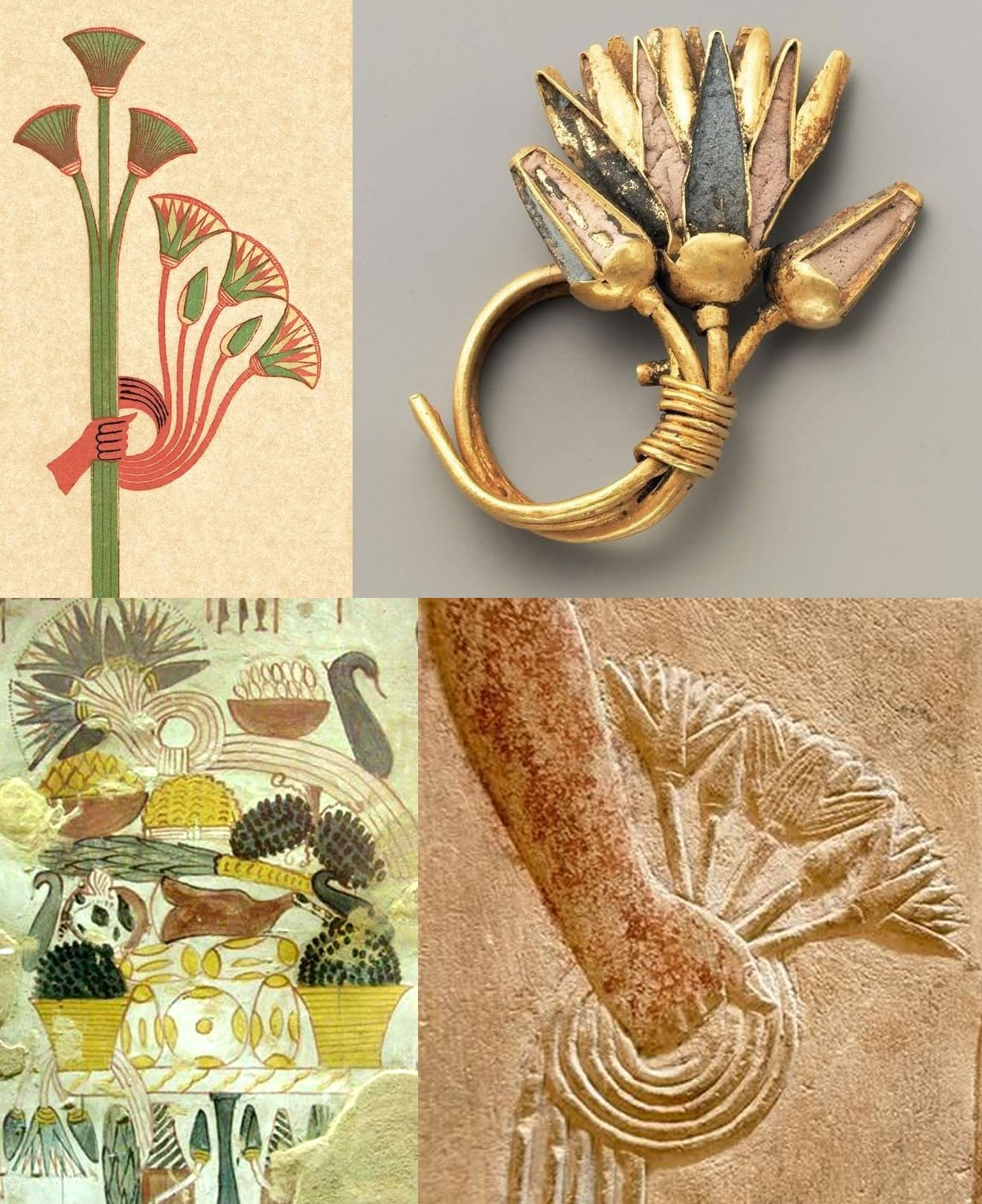
Notice the resemblence to a Shen portal, having a ring and
                                      a lashing on the edge of the ring. Handgrip is equivalent to the lashing.

There are many ways in symbolism that a hand is a portal symbol, including fingers in various poses. When the fingers are curled around a slender object like a staff, a bird's neck, or a vine, it resembles rope lashings.

This gives support to the theory that ancient people believed that a portal needed to be anchored to a barrier, fixed in position. In addition to rope or grasping fingers, the ancients also used biting and stabbing symbols (not shown) to label and pin a portal location, creating a flow connection.

Center Flow Column with lashings

Rather than actual trees, these represent center flow paths using a column symbol. The top, bottom and midway horizontal-plane portals are all labeled with rope lashings.

The arch-shaped outer symbols represent barrier surface outflows of the torus.

Portals at the bottom, middle and top are labeled with rope lashings.
The center flow path is using a column symbol and it has
                                      portals labeled by lashings at the bottom, middle and top.
A center flow path using a column-symbol has portals
                                      labeled with lashings at the bottom, horizontal plane and top.
A fasces center flow path using a column-symbol has portals
                                      labeled with lashings at the bottom, horizontal plane and top.

Are You Convinced?

All of these examples demonstrate that the most famous symbols in the world feature portals, with rope wrap lashings marking the portal locations.

  • The Ankh has a portal at the horizontal-bar dimension barrier.
  • The Shen is a ring portal lashed to a barrier, with a flow symbol passing through it.
  • The Djed represents a center flow column symbol with a midway portal to a higher dimension.
The Ankh symbol has a horizontal bar representing a dimension barrier.
                                      The rope lashing marks the location of a portal. The flow path is vertical
                                      and goes up into the loop and then comes back down. The downward flow
                                      is considered divine and supportive of life.
The Shen symbol is a ring portal that has rope lashing
                                      onto a linear barrier symbol.  This example has a flow
                                      symbol passing upward through the Shen portal.
The rope lashing on a Djed occurs at its waist, which is the
                                      horizontal plane. Djeds are the central flow path through a torus and
                                      just above the horizontal plane is considered as a higher dimension.
                                      The Djed stacks several higher dimensions, similar to the Stupa and
                                      Yggdrasil tree, which has 3 higher dimensions above Midgard.

Section II

The Djed

The Egyptian Djed symbol. It means an upward energy flow path leading to multiple higher dimensions, rather than "strength", "stability", a spine, or other conventional platitudes.

The Djed has a suitable meaning for a funeral memorial (Nefertari's tomb) or on stelae pictograms, referencing the path to higher dimensions.

Symbolism has a wide variety of center flow path symbols. They can be a Djed, a tree trunk, a column, a person-symbol and many others. "The Three" in symbolism layouts refers to a center flow path and two side flows.

In ancient Tibetan and Himalayan teachings there were quite a few higher dimensions. The Stupa symbol uses those stacked umbrella shapes to represent portals to higher dimension. The purple-colorized cloth streamers are a visual marker for the horizontal plane of a Stupa, the same meaning as the rope lashings on a Djed.

The Norse Yggdrasil tree has three dimensions above our Midgard level; Asgard, Alfheim and Vanaheim.

The Djed is a center flow path symbol for a torus that is
                                      not showing its outer barrier.  There is a rope lashing at the
                                      middle on its horizontal plane. This plane is often considered to be
                                      a portal to a higher dimension.  Himalayan ancient teachings had
                                      many more higher dimensions than the typical three shown by the Djed.
                                      The Norse Yggdrasil tree has three dimensions about our Midgard level.

The Djed's four horizontal platforms each act like the brim of a cup, where the brim is the portal level that separates one dimension from another. The little lines beneath the bigger horizontal lines, are a barrier symbol, also found also in other portal configurations.

Worldwide symbolism uses heads as portals for a body-torus. Rather than seeing Bes and Hathor as deities, view their heads as portals. Above the heads are the little lines symbol (see below) and then a horizontal brim. Those are the barriers to the next dimension.

Bes has straight feathers above the brim, indicating upward flow direction. Hathor as a row of little snakes, which are upward outflows. Barrier surfaces have little outflows. Then there is a larger snake showing upward flow into an empty "void". That structure around the void door is a portal symbol. The "open door" symbol is typically for upward flow. Anubis with ears up is an upward flow label sitting on the barrier. The Eye with wings in "corner angled" pose is likely an upward flow portal symbol as well.

Bes
Hathor
portal is black
Anubis

Section III

Little Lines

This section shows examples where "little lines" are used on barriers.

The upper barrier is colorized purple. The lower barrier with
                                      zigzag pleats is colorized blue.
This is three layers of barriers. Little lines at the top,
                                      alternating flower symbols in the middle, and pleats at the bottom.

The upper barrier is colorized purple. The lower barrier with zigzag pleats is colorized blue-green.

On boat symbols, the boat is on the horizontal plane of a portal, and everything above the boat deck is considered to be in the higher density dimension. Look for the little lines below the boat deck. Horizontal planes are a barrier and they have a portal function.

The wavy little lines below the boat-symbol are the barrier,
                                      not literal water.
The straight little lines below the boat-symbol are
                                      the dimension barrier and there is a little gap representing
                                      a portal.
The wavy little lines below the boat-symbol are
                                      the dimension barrier

Wings are a barrier symbol and petroglyphs show them with a "little lines" pattern.

Ancient people chose wings as barrier symbols for a reason, and perhaps they knew the fine structure of barriers like the magnetopause and heliopause, and perhaps feathers resemble that.

Wings are a barrier symbol and petroglyphs often
                                      show wings with little lines.
The wings are marked with little lines because wings
                                      represent a barrier.
Ancient people chose wings as barrier symbols for a reason,
                                      and perhaps they knew the fine structure of barriers like the
                                      magnetopause and heliopause, and feathers resemble that.
                                      Magnified view of a peacock feather.

Section IV

Inspiration

Ancient knowledge is being recovered to provide inspiration about how the universe potentially works, hopefully.

Raising questions like: Why are wings a barrier symbol? Why are little lines a barrier symbol?

When magnetic flux spills out of the end of a flux tube, or passes through a portal into a different torus or dimension, it very quickly reassembles barrier surfaces to form new smaller flux tubes, and it apparently can inflate new torus bubbles with an outer barrier around that torus.

If you arrived to this page directly without reading the basic chapters, now is a good moment to read Chapter 4, Barriers to further appreciate ancient thought on barriers. Also Chapter 3, Flux Tubes reveals a lot.

The idea of self-assembly of barrier sheets seems like a 2D crystallization. Feather structure resembles ice crystal patterns, and iron oxide dendrite patterns, and graphite 2D sheets of carbon crystals. If nature can do this with atoms, it ought to be able to do it with tori of sub-atomic sizes.

The images below are of feathers, iron- and manganese oxides, graphite, and ice crytalization.

Partially overlapping feathers make wings.
Dendritic iron and manganese oxides in a 2D crystalization sheet.
Ice crystal in branching dendritic pattern.
Closeup of little lines of feathers.
Graphite as 2D sheets of crystalized cross-linked sheets.

Section V

Captives

The lashing of elbows or wrists carries a hidden symbolic meaning. Lashing marks the location of a portal, as demonstrated throughout the examples on this page.

The Best Evidence about Lashed Elbows: An Example from Egypt

Outflow from the snake mouth becomes inflow to the person-symbols
                                      with rope lashing portals at the elbows. Downward arms also indicate
                                      they are receiving downward energy flow.  Dots are an energy flow symbol,
                                      an open mouth of a snake is the open end of a flux tube.

Elbows carry a symbolic meaning referencing the horizontal plane of a torus. This is demonstrated on the Cloth Streamers page, particularly the section about cloth crossing-over the elbow or forearm.

Wrists also have a symbolic meaning. In ancient symbolism, arms represent flux tubes and wrists are the distal end where flux exits the tube. Wrist portal symbols were covered on the page examining bangles with converging heads rings.

Analyzing the Components

In the images below, both snake bodies represent upward-flowing flux tubes. Snake heads and lion heads each serve as outflow symbols with open mouths acting as portals.

Dots and small circles represent energy flow throughout ancient symbolism. The brim of a water well is a portal symbol while a flux tube containing dots is flowing upward and then returning downward as a loop-back.

Loop-backs are a central theme in ancient symbolism. Arches positioned above two columns likewise depict this loop-back energy flow cycling. That is, energy that returns to us from a higher dimension in a divine high-density state.

Arches are dual symbolic role: depicting loop-back flow paths while simultaneously also serving as the upper barrier symbol to the torus beneath. The keystone position of an arch often has a barrier penetration portal symbol (though not in this instance). In this colorized diagram, blue represents the flow inside the flux tube and orange represents the small outflows from the surface of the tube.

The snake and lion images from Egypt represent loop-backs, carrying a divine downward energy-flow meaning. The headgear on the lion likewise has this same meaning.

The upward snake is an upward energy flow, its mouth is
                                      the open end of its flux tube. The dots are an energy flow symbol,
                                      they are shorthand for the vortex/eddies that are seen in other
                                      flux tube symbols.  Overall this is a loop-back, a flow that goes up
                                      and comes down in a more divine high-density form.
The lion is an upward energy flow symbol, its mouth is
                                      the open end of its flux tube. The dots are an energy flow symbol,
                                      they are shorthand for the vortex/eddies that are seen in other
                                      flux tube symbols.  Overall this is a loop-back, a flow that goes up
                                      and comes down in a more divine high-density form.
The curved arch above two columns is a double-duty symbol. It
                                      can be a flux tube with blue-colorized flux on the inside and
                                      orange-colorized little outflows from its outer surface. The
                                      arch is also an upper barrier of a torus, and often has a
                                      portal at top-center. The brim of a well is a portal symbol.  In this case the
                                      flux tube comes out, goes up and then does a loop back and returns down.

Thousands of Aquarius pictograms exist because they represent the downward flow of energy (the core subject of ancient symbolism). The receiving symbols, such as cups, bowls, or chalices, act as downward inflow portals.

The brim of a chalice serves as a portal, while a bent-over person-symbol represents a downward flow symbol. A "looking-back" head (a head turned to look back at its body) is an inflow symbol.

Pouring seeds functions very similarly to the snake outflowing dots, and their destination is to the waist, the horizontal plane, the core of the person-symbol torus.

An Aquarius style layout pouring dots (of energy) out of a container.
The outflow source is the upper container, the destination
                                      is the brim of the chalice, which is a portal symbol separating
                                      one dimension from another.
A person-symbol who is bent or looking downward is a
                                      downward flow symbol, the receiver of the downward flow from above.
Pouring seeds are a flow symbol and their destination
                                      is inflow into the core of this person-symbol.

Hover over an image to read more details about it.

Secondary Evidence regarding lashings on elbows and wrists.

Captivity or servitude imagery does not carry the the literal meaning into symbolism. The lashing simply marks the portal location and the true significance is the flow directon of forearms and hands distal to the lashing portal.

Arms are horizontal plane flux tubes. Side loops
                                              on elbows and the knot that also is the origin of the
                                              cloth streamers also indicate that the arms are
                                              representing horizontal outflows.  The direction that
                                              forearms is pointing is downward. That's how
                                              symbolism generally works for human arms and animal
                                              forelegs.  These are downward flow person-symbols.
The black person-symbols are upward flow marked with
                                              Anubis up-ears and upward arms and hands.  The interior
                                              red person-symbols are downward flow because of the direction
                                              of their forearms.  They are small, which is another way to
                                              label divine high-density flow symbols.

The red person-symbols mean downward inflow and the outer black symbols with arms and ears up are upward outflows. Smallness for the divine inflow is a high-density label technique.

Sebastien is the inflow recipient of arrow flow symbols. The
                                      archers are the outflow. We cannot see the lashings presumably
                                      on the wrists.
This Sebastien has downward flow at crossed wrists.
This Sebastien has bidirectional vertical flows, up and down
                                      as well as the horizontal inflows via arrow-symbols.

Saint Sebastian as a person-symbol is receiving horizontal inflow that uses arrows as flow symbols. The Archer was the outflow source. The rope lashing on wrists indicate the arm portals are having downward flow.

Another depiction of Saint Sebastian also features horizontal inflow from arrow symbols. He has bidirectional arms, one for upward outflow and the other for downward flow.

This mandrake has downward forearms and upward foliage
                                      above a head portal. Mandrakes are bidirectional flow symbols.
A simplified mandrake. There is a portal at the top of the
                                      head, and the foliage is energy outflow upward, expanding into the
                                      new dimension.  The wavy hair is the downward symbol. Mandrakes
                                      are bidirectional flow symbols.

Mandrakes feature a portal at the top of their heads and the foliage above serving as typical outflow symbol, much like branches on a tree trunk marking the boundary to the next higher dimension. Meanwhile wavy hair indicates a downward outflow direction from the head-portal. Mandrakes are bidirectional flow symbols, earning divine status because downward energy flow is what ancient tradition valued as divine.

Downward arms are often rope lashed at the wrists on mandrakes, though not on this particular example.

Next, we compare upward praying hands with downward crossed wrists, which represent opposite polarities.

Upward hands resemble praying or worshipping, but carry a simpler hidden meaning about upward direction flow of energy.

When wrists cross at the midline, it signifies an inflow to the core. More technically, the flow begins as a horizontal outflow from the shoulders into the arms; the arms then execute a side loop, returning that flow back into the core as a divine inflow.

Crossed wrists may or may not include rope lashing. The lashing simply labels the open end of an arm flux tube, nothing more.

The Three. A center flow and two side flows. The person-symbols
                                      with wings indicate they are portals for upward and downward flow.
                                      They are opposite polarities.
                                      The center person-symbol as a crown for upward flow and a downward
                                      sword, making him a bidirectional symbol.
The Annunciation iconography allows many variations for
                                      teaching symbolism. This one is using the open pages of a book portal,
                                      and associating them with an upward outflow polarity and an
                                      inflow crossed-wrists polarity.

Opposite polarities: upward hands and crossed wrists.

Each person-symbol, Mary and Gabriel, is associated with half of the open book portal symbol. Open books frequently depict both polarities.

Upward outflow arms with wrists that are rope-lashed to
                                      simply show a distal arm portal and a proximal portal at the shoulder.
Vesica Pisces shape for the core of the body-torus. The crossed
                                      wrists with downward inflow to the core.

Opposite polarities: upward hands and crossed wrists.

A vesica pisces shape, placed instead of a rope lashing, represents the core of a body-torus.


References: All of the images seen on this page are part of larger image collections on Pinterest. Do you need to see more examples of: Ankh, Djed, Portals, Flux Tubes, Barriers, Side Loops, Flow symbols, Loop-Backs, Waist portals, Wings barriers, Cloth Streamers, Columns, Stupa, Hand Grips, Lashing.

Shareable

Up Next

No next page yet

But Dr. Halls Posts on Symbolism can be next