Arms are Flux Tubes
Arms are horizontal plane inflows and outflows
Recall the torus diagrams having four portals, where the vertical flow path through a torus has top and bottom ring portals and the horizontal plane flow has ring portals on the sides.
When a person-symbol is used to represent a torus diagram, the oldest custom was to tuck the elbows in near the waist, because the waist is considered the horizontal plane.


Arms at waist level are supposed to represent magnetic flux in flux tubes that is either flowing inward or outward from the torus.
V-shaped arms is a worldwide symbolism pose designed to put the arms at waist level, to equate them as horizontal plane flow connections.
Hover over an image to read more details about it.
KEYWORD DEFINITIONS: Torus, Portal, Flux Tube, Barrier, Side Flows, Horizontal Plane
Later in history, arms were allowed to originate at shoulders, but they still mean flow connections involving the horizontal plane. Usually arms do not mean a specific flow direction, they can be inflow to the body-torus or outflow away from the body core.
Clothing can be a barrier symbol around a person-torus
and Sleeves are often the barrier walls around arm flux tubes.


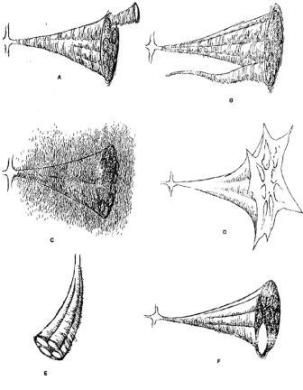
Sleeves are barrier symbols of flux tubes and can be marked with outflow surfaces using fleur-de-lis or stars. Sleeves that flare to an open end is the fate of many flux tubes.
Expanding and spilling flux tubes.
The fate of energy.
Even while energy flux is still within its flux tube, the flux tube tends to expand until its pleats wall is fully stretched, and then the flux energy spills out. Small new flux tubes are amongst the energy spilling out, and other parts of that energy will expand at first because the surrounding pressure is suddenly less than inside a flux tube. Later, that energy starts curling up into spiral vortices and eventually gets so small from deflation that it disappears.


Hands are portal symbols
And fingers are smaller final flux tube branching before it all disappears.
Every symbol shown on the palm of a hand below is a portal symbol. There are so many to choose from.


Arms and Hands connect to symbols
Introduction to Side Flow Symbols.
Flows outside of a main subject torus are outside or "side flows". On a two-dimensional diagram (a symbol layout pictogram), the most common layout uses just one side flow on the left and another on the right side. They are very commonly opposite polarity symbols. It is a simplified diagram for teaching.
However, the 3D torus can be surrounded by energy flows going in many directions, and there can be many arms, aka flux tubes going in and out of the torus.
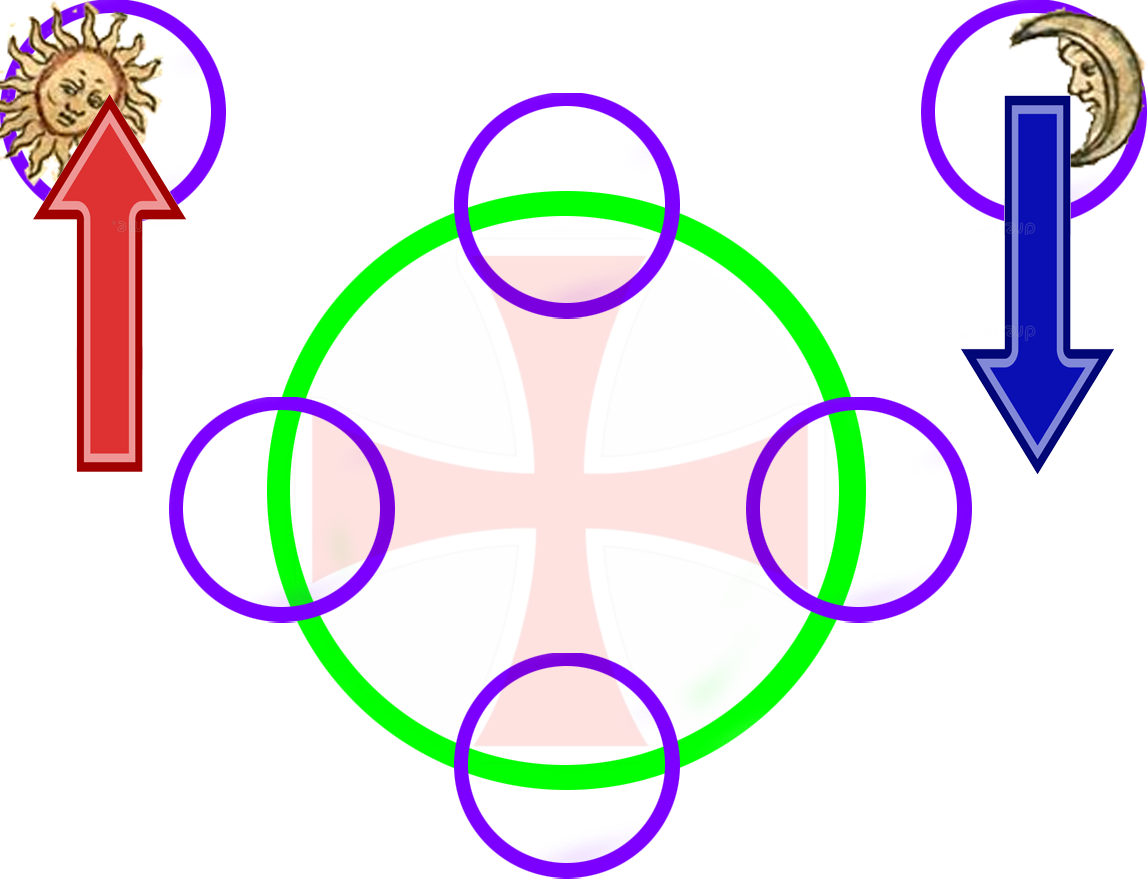


The Wheel of Fortune is an example where you must discard the well-known story. The circle is either the outer torus barrier or the barrier around the core ( an inner torus inside a torus ).
Person-symbols showing upward and downward direction is the tip of the iceberg. The crown is the center vertical flow path portal. Angel, bird, bull and lion are diagonal portal symbols. Angel for upward (equivalent to Sol), Eagle (equivalent to Luna and all curved-beak-birds), Bull is a downward symbol, Lion is an upward symbol.
The Up and Down pattern
In the examples below, none of the side flow symbols are to be interpreted as literal. Not literal swords, fish, snakes, etc. They show flow directions, and this collection of over 100 examples of the "Up and Down" pattern is fundamental to interpreting symbolism correctly.


Knowing the Up and Down pattern is amazingly helpful because if you recognize the polarity of one side, you can hypothesize that the other side is opposite polarity.
Down side flows can be bidirectional.
It gets more complicated because the Down side flow can be bidirectional, meaning that flow goes up into the higher dimension and then comes back down. A Luna portal and a Conch portal are examples of portals for bidirectional flow coming down to us.
Animals representing flow can do a "loop-back" pose with their neck, which means the flow went up and then came back down. These are divine high-density bidirectional symbols.


The trident is showing upward side flow. The horse's neck is doing a loop-back, meaning downward (but bidirectional) flow, so it is opposite polarity of the trident.
The lion is an upward side flow. The vertical center path is that plant stem. The unicorn neck is doing a a loop-back, so it is the downward bidirectional side flow symbol.
Multiple Arms means many flux tube connections along the horizontal plane.
The symbols held by hands have various meanings, but simplified, some are portals and some are labels of flow direction. Some go outward beyond the torus barrier, others loop back into the core.


The origins of flux tubes emerging from portals commonly shows a helical structure. An ancient example and a carved ivory example of this knowledge preserved into the 18th century.
The ability of flux tubes to make connections to other tori is demonstrated.
More Horizontal Plane flows that are not arms.
Other ways to show horizontal flow from a person-symbol body-torus.


Animal forelegs are like arms
Forelegs are horizontal plane outflows that can curve up or down.


Arms, Cloth, Vines
Cloth can show flow connections to side flow symbols, just like arms.
Vines, plant stems and various other objects can serve as flow connections.
Animals are fairly common side flow symbols, with arms making connections to them. Small people as person-symbols of flow are also quite common, and they can use their own arms to indicate flow connections. Smallness is a way to label something as higher-density. It does not mean there is a giant at the center or that children are literally involved.


Although the up and down pattern is most common for side flows, some pictograms have both sides up, and some are both sides downward flow.


The Three
This layout of a center vertical flow path person-symbol and two side flow symbols, is the most common layout of symbolism pictograms, worldwide.
It is a major milestone for your mental flexibility to realize that all these are just diagrams of a simplified torus and two side flows, and they basically all mean the same thing. It is much simpler than we were formerly taught. One center and two side flows.